
Signs of Rodents in Your Home: What Mississippi Gulf Coast Homeowners Shouldn't Ignore
Rodents rarely announce themselves. By the time you spot one running across the kitchen floor, there are likely dozens more you haven't seen. On the Mississippi Gulf Coast, where the climate stays warm and food sources are plentiful year-round, waiting for visible proof before taking action is a costly strategy. Over our 13 years of serving Gulf Coast homes, we've found that most infestations are already well established by the time a homeowner realizes something is wrong. Knowing the early warning signs changes that entirely.
What Are the Signs of Rodents in Your Home?
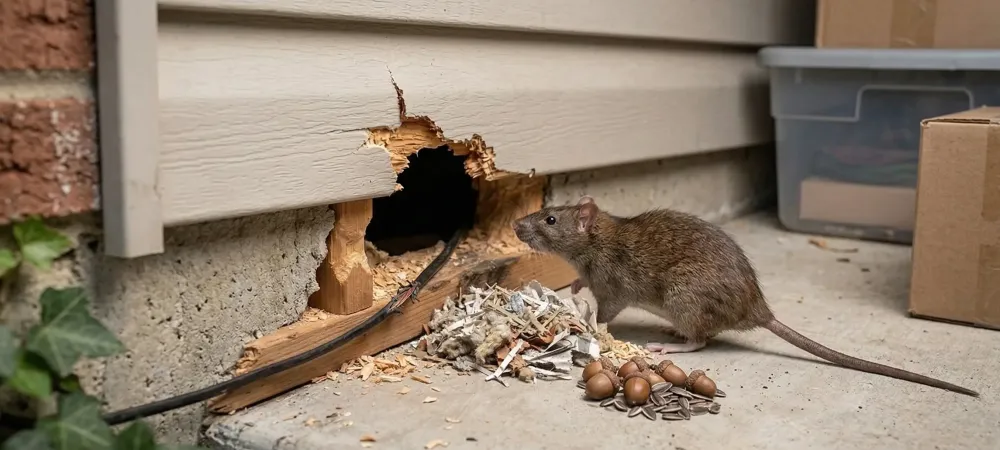
The most common signs of a rodent infestation are droppings near food sources or along walls, gnaw marks on packaging and wiring, grease smears along baseboards, shredded nesting material in hidden areas, and scratching or scurrying sounds at night. On the Mississippi Gulf Coast, roof rats, Norway rats, and house mice are all active year-round, so these signs can appear in any season, not just winter.
Fast Facts
- Rodents leave clear evidence long before you ever see one. Droppings, gnaw marks, grease trails, and nesting materials are the signs most homeowners overlook.
- The Gulf Coast climate means rodent activity has no off-season. Roof rats, Norway rats, and house mice remain active and reproductive year-round in coastal Mississippi.
- Health and structural risks escalate quickly. Rodents spread disease, contaminate food, damage wiring, and infestations grow fast once established.
Why Rodents Are a Year-Round Problem on the Gulf Coast
In many parts of the country, rodent activity spikes in fall and winter as temperatures drop and rodents seek warmth indoors. On the Mississippi Gulf Coast, the climate doesn't offer that natural reset. Warm, humid conditions throughout the year mean that roof rats, Norway rats, and house mice stay active and keep reproducing in and around homes every month of the year.
The Gulf Coast's older housing stock, pier-and-beam foundations, crawl spaces, and proximity to vegetation and water give rodents abundant harborage. A single pair of house mice can produce five to ten litters per year with six to eight pups per litter. That math moves fast. Understanding how Gulf Coast humidity creates year-round pest pressure helps explain why rodent populations here don't follow the seasonal patterns people expect.
What Draws Rodents Into Gulf Coast Homes?
Rodents need three things: food, water, and shelter. Gulf Coast homes often provide all three without homeowners realizing it. Gaps in the roofline or soffit let roof rats enter from above. Unsealed pipe penetrations and foundation cracks give Norway rats and mice ground-level access. Once inside, attic insulation, wall voids, and crawl spaces offer nesting material and protection.
What we've found after years in the field is that rodent entry points are almost always smaller than people expect. According to the Mississippi State University Extension Service, mice can squeeze through a gap as small as a quarter-inch, and rats need only half an inch. Most homeowners walk right past entry points because they're looking for large, obvious holes.
Post-storm debris, displaced vegetation, and moisture intrusion also push rodents into structures. Post-storm pest activity on the Gulf Coast is one of the most common triggers for new infestations we see following hurricane and tropical storm events.
Seven Signs You Have a Rodent Problem
- Droppings are often the first clue. Mouse droppings are small, about the size of a grain of rice, pointed at both ends, and dark when fresh. Rat droppings are larger and capsule-shaped, typically found along walls, in cabinets, under appliances, or in pantry areas. Fresh droppings signal active infestation; older gray droppings indicate past activity.
- Gnaw marks on food packaging, wood trim, baseboards, electrical wiring, and PVC pipe are a hallmark of rodent activity. According to the CDC, rats and mice gnaw continuously to keep their teeth at the proper length, leaving distinct marks that confirm their presence. Fresh gnaw marks are lighter in color; older ones darken over time.
- Grease trails and rub marks appear along baseboards, walls, and pipes where rodents travel the same routes repeatedly. The oils in their fur leave dark smears that indicate consistent, regular activity.
- Nesting materials such as shredded insulation, paper, fabric, or plant matter gathered in a hidden corner, behind appliances, in wall insulation, or in the attic, indicate an established nest site nearby.
- Sounds at night are a telling sign. Scratching, scurrying, or squeaking in walls, ceilings, or under floors after dark is a strong indicator that rodents are active inside your structure.
- Pet behavior changes are worth paying attention to. Dogs and cats often detect rodents well before humans do. If your pet is fixated on a particular wall, cabinet, or corner without explanation, it's worth investigating.
- Damaged food packaging, such as gnawed corners on boxes, bags with small holes, or scattered food debris in cabinets, means rodents are actively accessing your food supply and contaminating far more than they consume.
Can You Handle a Rodent Problem Yourself?
For a very limited, early-stage problem with one or two mice caught quickly, a combination of snap traps and entry-point sealing can sometimes resolve the issue. The CDC recommends traditional snap traps as the safest DIY option and advises against glue traps, which cause rodents to urinate in panic and increase disease exposure risk.
The problem with DIY rodent control isn't the traps. It's the scope. Snap traps catch individual rodents; they don't address the colony behind the wall, the access points still being used, or the nesting areas where new generations are already being born. The MSU Extension Service notes that for every rodent seen during the day, there are likely 20 to 50 more that aren't visible. Trapping a few mice without sealing entry points and eliminating harborage is like bailing a leaking boat without patching the hull.
What Professional Rodent Control Actually Looks Like
At Mayley's Pest Control, our rodent control services don't start with traps. They start with a thorough inspection. We identify how rodents are getting in, where they're nesting, what's attracting them, and how extensive the activity is before recommending a treatment plan.
Our process typically includes:
- Entry point identification and exclusion recommendations, sealing gaps around pipes, utility lines, the roofline, and foundation with materials rodents can't chew through
- Strategic trap and bait station placement in activity zones, with tamper-resistant stations that are safe around children and pets
- Nesting site removal and sanitation guidance to eliminate harborage that supports re-infestation
- Follow-up monitoring to confirm the population has been eliminated and no new activity is occurring
If you're already on a home pest control plan with us, ask about adding rodent monitoring to your service schedule, especially going into spring when displaced populations from storm activity often move into coastal homes.
Getting a free inspection before a small problem becomes a large one is almost always the smarter financial decision. Call Mayley's Pest Control at 228-380-0295 to schedule yours.
Why a Rodent Infestation Is a Health Issue, Not Just a Nuisance
Rodents are a documented public health risk. The CDC identifies hantavirus as one of the serious diseases spread through contact with rodent urine, droppings, and saliva. Hantavirus Pulmonary Syndrome can be contracted simply by disturbing contaminated material and breathing in the aerosolized particles, which means cleaning up a rodent nest without proper precautions is a genuine hazard.
Beyond hantavirus, rodents carry salmonella, leptospirosis, and other illnesses that spread through food and surface contamination. Their gnawing on electrical wiring is also a significant fire risk, one that doesn't show up until it's too late to prevent.
If you discover a nesting site, don't vacuum or sweep it. Wet the area thoroughly with a bleach solution first, wear gloves, and avoid stirring up dust. For significant infestations, professional cleanup and remediation are the safest path.
Reducing Rodent Risk in Your Gulf Coast Home
Prevention is always easier than elimination. These steps reduce the conditions that attract and support rodents:
- Seal gaps around pipes, conduits, and utility penetrations with steel wool and caulk or metal flashing
- Keep food, including pet food, in sealed hard-sided containers rather than cardboard boxes or bags
- Remove standing water sources; fix dripping faucets, clear clogged gutters, and address low spots in the yard
- Keep vegetation, woodpiles, and debris at least 18 inches away from the foundation
- Trim tree branches that overhang or contact the roofline; roof rats use these as access highways
- Check attic vents, soffit gaps, and roof eaves seasonally for new openings
- Use outdoor garbage bins with secure, locking lids
For year-round context, keep an eye on the seasonal pest patterns in the Gulfport-Biloxi area so you can take action before pest pressure peaks in your neighborhood.
When It's Time to Call Mayley's Pest Control
You don't need to see a rodent to justify a professional inspection. Call us when:
- You find droppings in more than one area of your home
- You hear scratching or scurrying sounds at night
- You've set traps, but keep catching rodents without the activity decreasing
- You notice gnaw marks on wiring, pipes, or structural wood
- You find a nest site in the attic, walls, or crawl space
- You've recently moved into a home that's been vacant
- Your neighborhood has experienced recent flooding or storm damage
Don't Let a Small Problem Become a Costly One
Rodent infestations in Mississippi don't resolve on their own, and on the Gulf Coast, they don't slow down in winter. The good news is that early intervention is both effective and affordable. Mayley's Pest Control has been handling rodent problems in coastal Mississippi homes for 13 years, and we offer free inspections, detailed treatment plans, and follow-up monitoring to make sure the problem is fully resolved, not just temporarily reduced.
Whether you're dealing with roof rats in the attic, mice in the kitchen, or just want to know if there's activity you're not seeing, call us at 228-338-1530 or request a free inspection online. Catching it early makes all the difference.
Sources
- "Controlling Wild Rodent Infestations." Centers for Disease Control and Prevention, 29 Sept. 2025, cdc.gov/healthy-pets/rodent-control/index.html.
- "About Hantavirus." Centers for Disease Control and Prevention, 13 Mar. 2025, cdc.gov/hantavirus/about/index.html.
- "Controlling Mice & Big Ole Rats." Mississippi State University Extension Service, 2021, extension.msstate.edu/newsletters/dawg-tracks-safety-talk/2021/controlling-mice-big-ole-rats.